
Your machine learning model is trained. Your product team is excited. Your first enterprise client is ready to go live.
Then the real problem starts.
The training job is waiting in the queue. CUDA versions are clashing. GPU availability is unpredictable. Your DevOps team is fixing infrastructure issues instead of helping the AI team ship faster.
This is where many AI projects slow down, not because the model is weak, but because the compute layer cannot keep up.
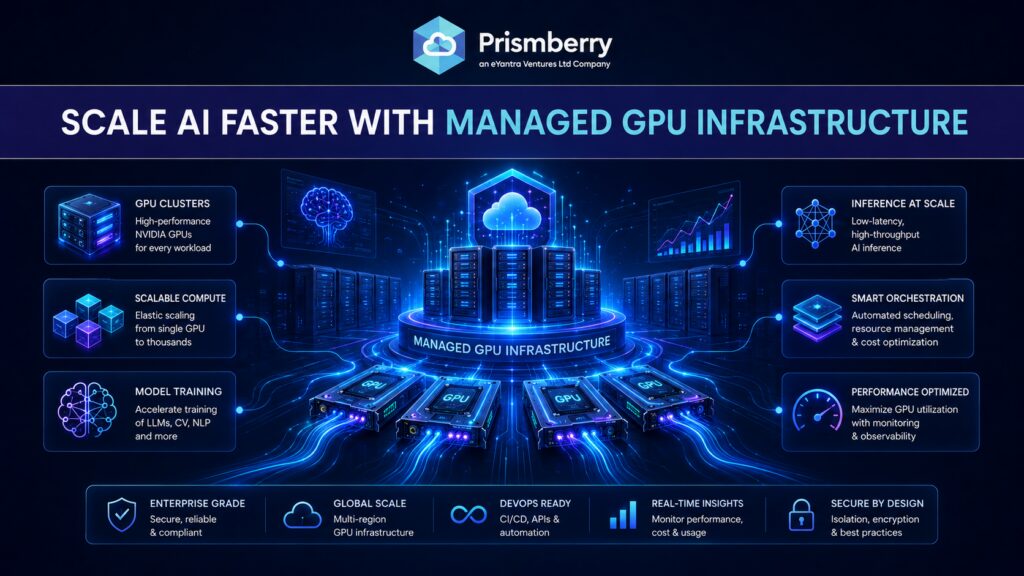
That is exactly why managed GPU infrastructure is becoming important for companies that want to scale AI without drowning in setup, maintenance, and cost complexity.
Let us break it down.
The Real Problem with AI Scaling
AI looks exciting in a prototype.
A small model runs in a notebook. A demo works well. A team gets internal approval.
But production AI is different.
Once workloads move from testing to real users, compute demand becomes unpredictable. Training jobs spike. Inference traffic rises. Fine-tuning cycles increase. Suddenly, the infrastructure has to support faster experiments, larger datasets, stronger security, and lower latency at the same time.
Traditional infrastructure was not designed for this pattern.
AI needs parallel compute. It needs high memory bandwidth. It needs optimized networking. It needs continuous monitoring. And most importantly, it needs systems that can scale without creating a new engineering problem every week.
That is the gap a managed GPU setup solves.

What Is GPU Infrastructure?
GPU infrastructure refers to the hardware, software, networking, storage, and orchestration systems that power AI and machine learning workloads.
Unlike CPUs, which are better suited for sequential tasks, GPUs are designed for massive parallel processing. That makes them ideal for deep learning, large language model fine-tuning, computer vision, generative AI, and real-time inference.
But GPU infrastructure is not just about renting a powerful machine.
A production-ready setup includes GPU clusters, drivers, CUDA libraries, ML frameworks, container orchestration, monitoring tools, security layers, storage pipelines, and workload scheduling.
In simple words: GPUs provide the power, but infrastructure decides whether that power is actually useful.
Why Self-Managed GPU Clusters Become a Bottleneck
Building your own GPU cluster sounds attractive at first.
You get control. You choose the hardware. You manage the stack. But that control comes with a cost.
Common issues include:
- Long hardware procurement cycles
- Driver and software compatibility problems
- Idle GPU costs during low usage periods
- Complex networking for distributed training
- Security and compliance overhead
- Limited internal expertise for optimization
The result is simple: your AI team spends too much time managing systems and not enough time improving models.
This is why many growing teams move from self-managed clusters to a managed GPU setup when their AI workload becomes serious.
Cloud GPUs Help, But They Are Not the Full Answer
Cloud GPU infrastructure was a major improvement because it gave teams access to compute without buying hardware upfront.
You can spin up instances, run experiments, test models, and scale capacity faster than traditional on-premise setups.
But raw cloud GPUs still leave a lot of work on your team.
Someone still has to configure the environment. Someone has to monitor usage. Someone has to optimize costs. Someone has to fix failures. Someone has to make sure security, compliance, and performance stay aligned.
That is where GPU infrastructure services become valuable. They do not just give you access to GPUs. They help you run the entire compute layer properly.
What a Managed GPU Setup Actually Changes
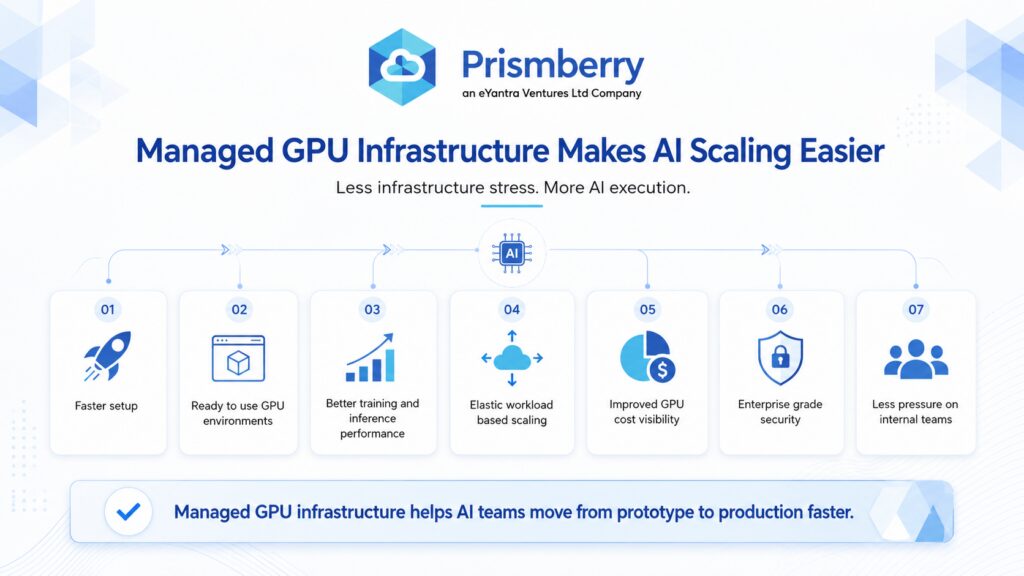
Managed GPU infrastructure removes the operational burden from AI scaling.
Instead of your team managing hardware, drivers, clusters, monitoring, and optimization, a specialized provider handles the full environment. Your engineers get ready-to-use compute that is already configured for AI workloads.
This changes the pace of development.
Training jobs can start faster. Infrastructure failures are handled faster. GPU usage becomes more visible. Costs become easier to control. Security becomes part of the setup instead of an afterthought.
Most importantly, your AI team gets to focus on models, data, product experience, and business outcomes.
Self-Managed GPU Clusters vs Managed GPU Setups
| Area | Self-Managed GPU Clusters | Managed GPU Infrastructure |
| Setup | Weeks or months of configuration | Ready-to-use environments |
| Maintenance | Handled by internal teams | Handled by specialists |
| Scaling | Manual and often slow | Elastic and workload-based |
| Cost Control | Difficult to track and optimize | Usage visibility and optimization support |
| Security | Built and maintained internally | Enterprise controls included |
| Team Focus | Infrastructure firefighting | AI development and deployment |
This is the main difference.
Self-managed systems give you control, but they also give you complexity. Managed systems give you speed, reliability, and a cleaner path to production.
Where GPU Infrastructure Services Make the Biggest Difference
GPU infrastructure services are especially useful when AI workloads are moving beyond experiments.
They help when companies are training large models, fine-tuning LLMs, running computer vision systems, building AI SaaS products, or serving real-time inference at scale.
They are also useful for businesses in regulated industries such as healthcare, finance, insurance, and legal, where security and compliance cannot be ignored.
For startups, the biggest advantage is speed. For enterprises, it is governance. For AI-first companies, it is the ability to scale without hiring a large infrastructure team too early.
In every case, the goal is the same: reduce friction between AI ambition and production execution.
Why Optimization Matters More Than Raw GPU Power
Buying or renting powerful GPUs is only part of the story.
The real gains come from optimization.
A poorly configured GPU environment can waste compute, slow training, increase costs, and create unstable performance. Managed providers continuously tune workloads, monitor utilization, optimize memory usage, improve scheduling, and reduce idle capacity.
For AI teams running expensive training or inference workloads, even small efficiency improvements can save serious money over time.
This is why the managed model is not just about convenience. It is also about performance economics.
How Prismberry Helps AI Teams Scale
At Prismberry, we help businesses build and scale AI systems with infrastructure that is reliable, optimized, and ready for production.
Our GPU infrastructure services are designed for teams that want to move faster without getting stuck in operational complexity. We help plan the right GPU architecture, configure the environment, support model training and inference needs, and optimize the infrastructure as workloads grow.
Whether you are building generative AI applications, fine-tuning models, scaling computer vision systems, or running enterprise AI workloads, Prismberry helps create a compute foundation that supports real business growth.
The goal is simple: your team should spend more time building AI and less time managing the systems behind it.
Final Thoughts: AI Scaling Needs Infrastructure That Can Keep Up
AI does not fail only because of bad models.
Many AI projects fail because the infrastructure behind them is slow, expensive, unstable, or difficult to scale.
Managed GPU infrastructure solves this by giving teams a faster, cleaner, and more reliable way to run AI workloads. It reduces operational stress, improves utilization, and helps businesses move from prototype to production with more confidence.
The future of AI belongs to teams that can build fast and scale intelligently.
If your models are ready but your compute is holding you back, it may be time to rethink your GPU strategy.
Frequently Asked Questions
Managed GPU infrastructure is a service model where a specialized provider handles the setup, monitoring, scaling, security, and optimization of GPU environments for AI workloads. Instead of managing clusters, drivers, software, and failures internally, businesses get a ready-to-use compute layer designed for machine learning, deep learning, and inference workloads.
GPU infrastructure is important because modern AI workloads require massive parallel processing. Training models, fine-tuning LLMs, running computer vision systems, and serving real-time inference all need compute environments that can handle high demand efficiently. Without the right infrastructure, even strong AI models can become slow, expensive, or unreliable in production.
Cloud GPUs give teams access to compute, but GPU infrastructure services go further by managing the environment around that compute. This includes configuration, monitoring, security, scaling, optimization, and support. For teams that do not want to spend time managing infrastructure manually, managed services are often more practical than using raw cloud GPUs alone.
Managed GPU infrastructure is useful for startups, enterprises, research teams, and SaaS companies that run AI workloads at scale. It is especially helpful when internal teams have limited DevOps capacity, when workloads are unpredictable, or when security and compliance requirements are important.
Prismberry supports businesses by designing and managing GPU environments for AI workloads. The focus is on building reliable infrastructure, improving performance, reducing operational complexity, and helping AI teams scale from experiments to production-ready systems.